

The Mardi Himal Trek is rapidly becoming one of the most popular short treks from Pokhara. Unlike the traditional Annapurna Base Camp route, Mardi Himal offers a pristine ridge-line trail with unobstructed views of Machhapuchhre (Fishtail) and the Annapurna range.
Because the trail runs along a ridge, there are several different ways to climb up to it. Whether you are looking for the longest, most scenic hike through traditional villages, or a rapid ascent from the valley floor, this guide breaks down all 6 Mardi Himal trekking routes to help you choose your ideal itinerary.
Before diving into the day-by-day breakdowns, here is how the different trailheads converge onto the main Mardi ridge:
Mardi Himal Route Convergence
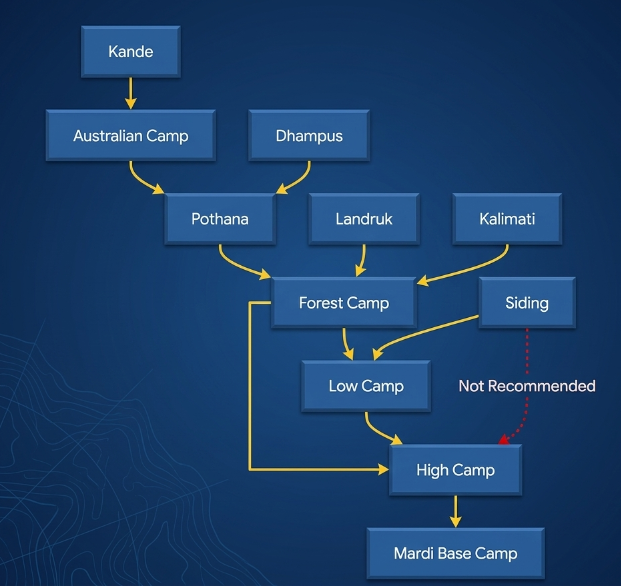
Visualizing the Routes
1. The Classic & Scenic Route (via Kande)
Best for: Acclimatization, photography, and experiencing classic tea house culture.
If you want the most scenic and longest variation of the Mardi trek, starting from Kande is the gold standard. It offers a gradual altitude gain, which is excellent for acclimatization, and passes through the famous Australian Camp before joining the main Mardi ridge.
- The Route: Kande – Australian Camp- Pothana – Pitam Deurali – Forest Camp – Low Camp – Badal Danda – High Camp – Mardi Base Camp.
- Why choose this route? You get to experience the lush forests and panoramic views from Australian Camp early in the trek. It breaks the initial ascent into manageable days with plenty of established tea houses.
2. The Landruk Approach
Best for: Trekkers combining Mardi Himal with the Annapurna Base Camp (ABC) or Poon Hill treks.
Landruk is a beautiful Gurung village accessible by off-road vehicles. From Landruk, the trail cuts steeply up the side of the ridge to join the main Mardi trail.
- The Route: Vehicle to Landruk – Forest Camp – Low Camp – Badal Danda – High Camp – Mardi Base Camp.
- Why choose this route? If you are already trekking in the Annapurna region (like finishing Poon Hill), crossing over to Landruk allows you to tack the Mardi trek onto your existing itinerary without returning to Pokhara.
3. The Dhampus Trail (via Pitam Deurali)
Best for: A traditional village experience with a slightly shorter start than Kande.
Similar to the Kande route, but starting slightly further east. Dhampus is a famous viewpoint village in its own right.
- The Route: Dhampus – Pitam Deurali – Australian Camp – Forest Camp – Low Camp – Badal Danda – High Camp- Mardi Base Camp.
- Why choose this route? It offers an excellent cultural introduction to the Gurung lifestyle in Dhampus before heading up into the remote forested ridges.
4. The Kalimati Short-Cut
Best for: Time-crunched trekkers who want to reach the alpine zone quickly.
By utilizing local jeep tracks, you can bypass the lower foothills almost entirely.
- The Route: Harichowk – Vehicle to Kalimati – (1.5 hr hike) – Forest Camp – Low Camp – Badal Danda – High Camp – Mardi Base Camp.
- Why choose this route? It shaves a full day off the standard itinerary by dropping you just a 90-minute walk below Forest Camp. Ideal for domestic trekkers or expats looking for a quick weekend getaway.
5. The Steep Siding Ascent
Best for: Downhill exits or aggressive climbers.
Siding is located in the valley to the east of the Mardi ridge. You can hire a jeep from Harichowk directly to Siding (approx. NPR 500 per person on a sharing basis, or NPR 7,500 for a private reservation).
- The Route: Harichowk – Vehicle to Siding – Low Camp – Badal Danda – High Camp- Mardi Base Camp.
- Why choose this route? The hike from Siding to Low Camp is a stiff uphill climb. Because of the rapid altitude gain, it is highly recommended to use Siding as your exit route rather than your starting point, to save your knees and prevent altitude sickness.
6. Siding Direct to High Camp (Not Recommended)
Best for: No one (Avoid this route).
While technically possible, taking a trail directly from Siding to High Camp is heavily discouraged for standard trekkers.
Why to avoid it: The trail is extremely steep, sees very little foot traffic (making route-finding dangerous if weather turns), and lacks adequate tea houses or lodges for emergency stops. Furthermore, jumping straight from Siding (1,700m) to High Camp (3,580m) in one push invites severe Altitude Sickness (AMS). Stick to the Low Camp route instead.
About The Author


