

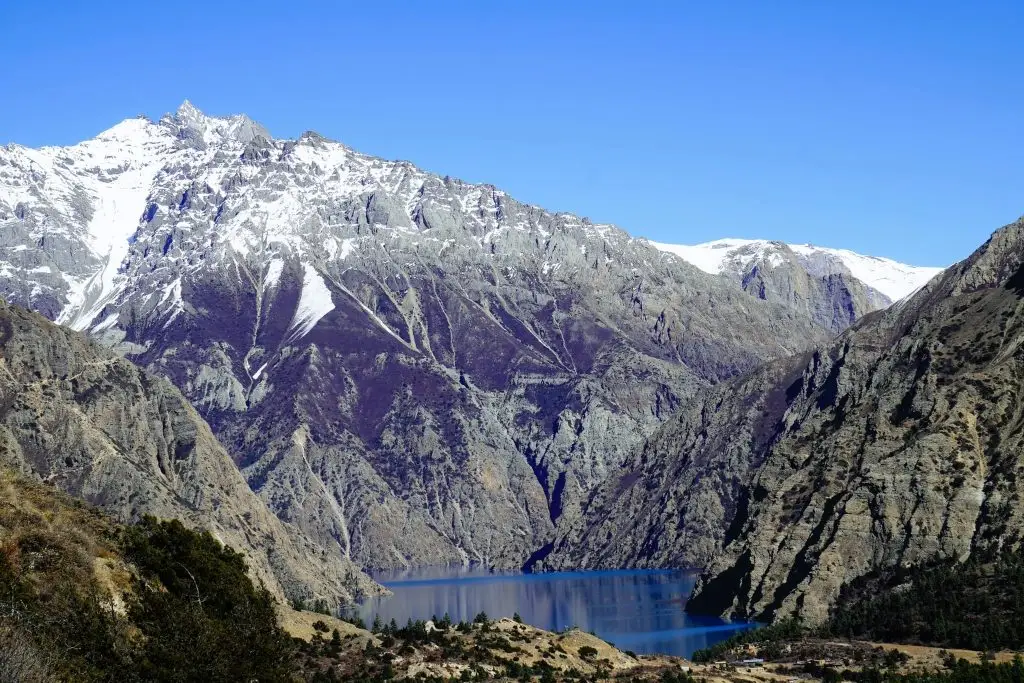
Trip Highlights: Explore the Isolated Bon-Po Tibetan Villages. Cross Vast Rain Shadow Areas in Lower Dolpo. Traverse High Suspension Bridges and Authentic Trails to Reach Ringmo Village. Encounter Diverse Flora and Fauna in Shey Phoksundo National Park. Marvel at the Snow-Capped Kanjirowa Massif (6,612 m) and the Unique Trans-Himalayan Landscape.
Trip Overview: Nepal’s Dolpo region is home to one of the most breathtaking lakes you’ll ever encounter – Shey Phoksundo Lake. This trek offers a once-in-a-lifetime opportunity to witness something truly extraordinary in pristine and stunning surroundings. Situated in the Dolpa district, Shey Phoksundo Lake is not only Nepal’s deepest lake but also a gateway to the unexplored beauty of this vast region.
As you embark on the Phoksundo Lake Trek, you’ll journey through lush forests housing various tree species, including oaks, pines, and firs. Along the way, you’ll traverse high suspension bridges and pass through traditional villages, such as Tshowa Monastery to the north of the lake and Ringmo Village to the south, known for its continued observance of Bon-Po culture. Trekkers also have the opportunity to explore several monasteries, including Shey Gompa and Thasung Gompa, nestled amidst the mountains.
Phoksundo Lake, at an impressive altitude of 3,611 meters, holds immense significance for Buddhists and Bon-Po followers, making it a holy and sacred site. The lake is located within Shey Phoksundo National Park, a haven for diverse plant and animal species. This national park offers a range of stunning landscapes, with the trek culminating at Phoksundo Lake, situated at 3,640 meters above sea level. It’s worth noting that trekkers need specific permits to access this restricted area of Nepal.
The region around Phoksundo Lake is one of Nepal’s most isolated and undeveloped areas, making basic accommodation facilities available at local teahouses and lodges. This trek, ideal for those with moderate fitness levels, can be completed within a week, making it accessible to adventurers and beginners alike.
Best Time to Trek: The best time for the Phoksundo Lake Trek is during autumn (September to November) when the weather is pleasant, offering warm days and cool nights. The stunning views of Phoksundo Lake and the surrounding valleys are at their peak during this season. Spring (March to May) is another excellent season with moderate temperatures and lush vegetation, including blooming rhododendrons. Trekking is not recommended during the monsoon season (June to August) due to harsh weather conditions and slippery trails.
About Phoksundo Lake Trek: The Shey Phoksundo Lake Trek is a renowned trekking route in the western region of Nepal. Nestled at an elevation of 3,640 meters, Shey Phoksundo is one of Nepal’s most celebrated lakes. Trekking through the Shey Phoksundo National Park offers an unforgettable experience with opportunities to witness rare flora and fauna and savor breathtaking views of the lake, waterfalls, valleys, and more.
Moreover, this trek allows you to explore remote areas, cross ancient salt trade routes, witness majestic yak caravans, and soak in the pristine beauty of the Kanjirowa Himalayas. The journey takes you through traditional villages like Dunai, Chhepka, Jharana Hotel, and Santa, and offers the chance to marvel at a 167-meter waterfall. The region is home to endangered species such as snow leopards, musk deer, blue sheep, and Himalayan Thar.
The trek concludes with a scenic flight back to the starting point in Jhupal, accessible via a flight from Nepalgunj. Upper Dolpo adheres to Tibetan culture, while lower Dolpo practices Buddhism, with some Bon-Po followers. Bon-Po followers circumambulate monasteries counterclockwise, adding to the unique cultural tapestry of the region.
Shey Phoksundo National Park – A Remote Paradise: Shey Phoksundo National Park is Nepal’s largest trans-Himalayan national park, spanning 3,555 square kilometers. Located in the Dolpa and Mugu districts, it is a region of unparalleled beauty and mystery. The park’s landscape is characterized by juniper forests in mountain deserts, creating a unique and pristine habitat for wildlife. The Dolpo region is divided into Upper Dolpo and Lower Dolpo, with the upper region being the least explored and most isolated due to its restricted status, requiring special permits for access.
This isolated paradise hosts an array of wildlife, including snow leopards, musk deer, Himalayan Tahr, blue sheep, Himalayan black bears, and jackals. Shey Phoksundo National Park is also known for its Buddhist monasteries, adding cultural significance to its natural wonders.
Phoksundo Lake – Nepal’s Deepest Lake: Phoksundo Lake, known for its mesmerizing blue-green hue, holds immense cultural and natural significance. Considered sacred by Buddhists and Bon-Po followers, it is Nepal’s deepest lake and one of its most unspoiled gems. Situated at an elevation of 3,640 meters above sea level, the lake’s crystal-clear waters are surrounded by majestic hills, creating a captivating panorama that resembles a work of art.
The lake covers an area of 5.15 square kilometers and reaches a depth of approximately 145 meters. The southern shore of the lake boasts over 20 stupas, while the eastern side features one stupa, and annual prayers and worship ceremonies are held here on special occasions. Nestled in the foothills of the Kanjieowa mountains, Phoksundo Lake’s distinctive Y shape and its vibrant turquoise color make it a truly captivating destination.
If our itinerary doesn’t align with your travel plans or if you’d like to customize your journey, please don’t hesitate to get in touch. We specialize in creating tailored travel experiences for various groups, including students, families, and corporate teams. Let us know your preferences, and we’ll craft a personalized itinerary to ensure you have an unforgettable adventure in this extraordinary part of Nepal.
Nestled in the rugged terrain of Nepal’s northwestern region lies Shey Phoksundo National Park, a natural wonder that embodies the essence of the Trans-Himalayas. Established in 1984 AD (2040 BS) and declared a national park in 1998 AD (2055 BS), this park spans an impressive 3,555 square kilometers, making it the largest national park in Nepal. Its primary purpose is to preserve the unique Trans-Himalayan ecosystem, which encompasses a rich diversity of flora and fauna.
Location: Situated between the coordinates 29°21′29″N and 82°50′44″E, Shey Phoksundo National Park is located in the northwestern part of Nepal. This vast expanse extends across two districts, Mugu and Dolpa, within the country’s western development region.
Climate: The park boasts a wide range of elevations, from 2,200 meters at Suligadh to an astonishing 6,883 meters at the summit of Kanjiroba. Consequently, the park offers a varied climatic experience. Winter above 2,500 meters often witnesses frequent snowfalls, and temperatures drop below freezing above 3,000 meters. The majority of rainfall occurs between July and September, with less than 500mm per year in the north and around 1,500mm in the southern areas.
Getting There: To embark on your journey to Shey Phoksundo National Park from Kathmandu, you have the option of road or air transportation. The road journey covers 317 kilometers and takes approximately 4 hours by bus. Alternatively, you can opt for air travel by flying from Kathmandu to Nepalgunj and then to Juphal airport in Dolpa. From there, a half-day walk will lead you to Suligad, the park’s entrance.
Wildlife and Vegetation: The park is a sanctuary for a diverse range of wildlife, including six reptile species and an impressive 32 butterfly species, with Paralasa Nepalaica being the world’s highest-flying butterfly. Shey Phoksundo National Park is also home to endangered species like the snow leopard, grey wolf, and musk deer. Blue sheep, Goral, Leopard, Jackal, Himalayan black bear, and more coexist in this biodiverse haven. Bird enthusiasts will appreciate the presence of 200 species, including the Tibetan Partridge, Wood Snipe, and Crimson-eared Rosefinch.
The park’s flora is equally stunning, with rhododendron, caragana shrubs, juniper, white Himalayan birch, and silver fir adorning the Trans-Himalayan slopes.
Local Population at the Buffer Zone: The buffer zone of Shey Phoksundo National Park, established in 1998, covers 1,349 square kilometers and is home to approximately 12,256 residents across 2,374 households. The majority of the local population practices Bon, an ancient religion rooted in Animism and Buddhism. The villages in this region are among the highest settlement areas on earth.
Things to Do and Places to Visit: Shey Phoksundo National Park offers a plethora of cultural and natural attractions. It boasts various gompas and religious sites, with Shey Gompa being a standout. The jewel in its crown is Shey-Phoksundo Lake, the world’s deepest and second-largest lake. In 2007, this pristine wetland area was declared a Ramsar site.
Historical and religious sites, such as the Thasung Monastery, built approximately 900 years ago, and the Shey Monastery, established in the 11th century, are must-visit destinations within the park.
Furthermore, Shey Phoksundo is a renowned trekking destination, featuring stunning flora, fauna, and captivating scenery. Individual trekking is permitted up to Rigmo or Phoksundo Lake, while the inner Dolpo areas are restricted to group trekking.
A journey to Shey Phoksundo National Park promises not only natural beauty but also a deep immersion into the rich cultural tapestry of this remote region, offering an unforgettable experience for adventure seekers and nature enthusiasts alike.
About The Author


First of all I would like to say great blog! I had a quick question in which
I’d like to ask if you do not mind. I was curious to
know how you center yourself and clear your mind prior to writing.
I have had a tough time clearing my mind in getting my ideas out.
I truly do take pleasure in writing but it just seems like the first 10 to
15 minutes tend to be wasted just trying to figure out how to
begin. Any ideas or tips? Thanks!
The offer is still valid. Details https://zetds.seychellesyoga.com/jml
Web Development Wizards https://zetds.seychellesyoga.com/info
Can provide a link mass to your website https://zetds.seychellesyoga.com/info
Your site’s position in the search results https://zetds.seychellesyoga.com/info
Web Development Wizards https://zetds.seychellesyoga.com/info
Your site’s position in the search results https://zetds.seychellesyoga.com/info
SEO Optimizers Team https://zetds.seychellesyoga.com/info
Cool website. There is a suggestion https://zetds.seychellesyoga.com/info
We’re a group of volunteers and opening a new scheme in our community.
Your site offered us with valuable info to work on. You have done an impressive
job and our whole community will be thankful to you.
You will definitely like it https://zetds.seychellesyoga.com/info
Content for your website https://ztd.bardou.online/adm
Can provide a link mass to your website https://ztd.bardou.online/adm
I offer mutually beneficial cooperation https://ztd.bardou.online/adm
Cool website. There is a suggestion https://ztd.bardou.online/adm
I really liked your site. Do you mind https://ztd.bardou.online/adm
Content for your website https://ztd.bardou.online/adm
Web Development Wizards https://ztd.bardou.online/adm
Can provide a link mass to your website https://ztd.bardou.online/adm
Free analysis of your website https://ztd.bardou.online/adm
SEO Optimizers Team https://ztd.bardou.online/adm
I offer mutually beneficial cooperation https://ztd.bardou.online/adm
Cool website. There is a suggestion https://ztd.bardou.online/adm
Content for your website http://myngirls.online/
Your site’s position in the search results http://myngirls.online/
Free analysis of your website http://myngirls.online/
SEO Optimizers Team http://myngirls.online/
I offer mutually beneficial cooperation http://myngirls.online/
Content for your website http://fertus.shop/info/
Web Development Wizards http://fertus.shop/info/
Can provide a link mass to your website http://fertus.shop/info/
SEO Optimizers Team http://fertus.shop/info/
I offer mutually beneficial cooperation http://fertus.shop/info/
Cool website. There is a suggestion http://fertus.shop/info/
I really liked your site. Do you mind http://fertus.shop/info/
Here’s what I can offer for the near future http://fertus.shop/info/
You will definitely like it http://fertus.shop/info/
The best prices from the best providers http://fertus.shop/info/
Additional earnings on your website http://fertus.shop/info/
Analytics of your website http://fertus.shop/info/
I would like to post an article http://fertus.shop/info/
How to contact the administrator on this issue http://fertus.shop/info/
Shall we exchange links? My website http://fertus.shop/info/
The offer is still valid. Details http://fertus.shop/info/
We offer cooperation on SEO optimization http://fertus.shop/info/
Content for your website http://fertus.shop/info/
Web Development Wizards http://fertus.shop/info/
Your site’s position in the search results http://fertus.shop/info/
Content for your website http://fertus.shop/info/
Web Development Wizards http://fertus.shop/info/
Your site’s position in the search results http://fertus.shop/info/
SEO Optimizers Team http://fertus.shop/info/
acheter levitra professional sans ordonnance en ligne
Awesome https://short-url.org/10VGf
This was such an eye-opening article. Really appreciate the depth and clarity!